October 25, 2010 at 12:07 pm
· Filed under Archives
It was reported by China Legal Daily that two Chinese businessmen were recently lured by secret agents of US to Hungary and later arrested and extradited to US for attempting to export anti-radiation PROM chips that can be used for outer space and military purpose, which are classified as USML items.
International Traffic in Arms Regulations (ITAR) is a set of United States government regulations that control the export and import of defense-related articles and services on the United States Munitions List (USML). U.S. Persons (including organizations) can face heavy fines if they have, without authorization or the use of an exemption, provided foreign (non-US) persons with access to ITAR-protected defense articles, services or technical data
Two Chinese exchanged emails with the secret agent who disguised as the CEO of an American trade company. The report said that they were misled that the transaction would be permissible via a third country. They were arrested when flew to Hungary to collect the goods from their trade partners. The Chinese report said they were entrapped by US secret agent and extradited without due process, such as presence of Chinese Counselor and Chinese translation of Hungarian court decision.
Interestingly, one of the Chinese, Yuan, was almost extradited from UK to US for Human Magic Power’s trademark dispute with an American company called ABRO Industrial 3 years ago. Yuan claimed that he was lured by Abro to UK for negotiation of the trademark ABRO ownership of which was under retrial at Beijing High Court but was arrested on aircraft landing in London Heathrow Airport. Fortunately Yuan managed to go home thanks to a misspelling of UK court decision. He did not have the same luck this time and has to face US court trial.
The series of entrapment extradition cases may alert the Chinese businessmen that they should be aware of foreign laws and regulations for international trade. However, ABRO trademark case is still puzzling. Based on limited information available, American Abro does not have any legal ground to seek criminal sanction under US law against a Chinese company that applied for registration of an identical mark with the Chinese Trademark Office. Perhaps, the Chinese company exported goods to US market using the mark ABRO.
It proves my guess that Yuan’s Hunan Magic Power indeed shipped alleged counterfeit goods to US and many other countries. In 2005,
Hunan Magic allegedly shipped $22,000 worth of products to Livingston Parish, Lousiana, sparking the charges that led to Yuan’s arrest in London. Under Louisiana laws, among the toughest in the U.S. against counterfeiting, he could face millions in fines and up to five years in jail.
Since the Chinese government has no extradition treaty with the U.S., meaning Yuan would likely only be sent back to face those charges by a third nation. That was the beginning of Heathrow arrest. US has extradition agreement with more than 100 countries. It seems it still pretty dangerous for Chinese businessmen who have been targeted by US law enforcement to go abroad.
Permalink
October 15, 2010 at 12:19 pm
· Filed under Archives, Conferences, Internet Governance
“Domain Name Dispute Resolution and ODR: Asian Perspective” was held on 15 October 2010 in Beijing Shangri-La Hotel New Wing.
The Conference is to further improve the substantive and procedural rules on domain name dispute resolution, develop relevant theories and practice in terms of online dispute resolution, strengthen the communication and cooperation of theoretical and practical workers in this field and promote the domain name and online dispute resolution services provided by ADNDRC. The conference is organized jointly by CIETAC, Asian Domain Name Dispute Resolution Centre and Hong Kong International Arbitration Centre.
Scores of presentations given by government officials, domestic and foreign scholars, judges, lawyers and representatives from enterprises were listened by a decent number of audience. A lawyer from Hong Kong, a Korean professor and Prof. Hong Xue gave the presentations in English. An ICANN staff from contract compliance department gave a briefings in Chinese. There were little chances for interactions. Presenters did not even talk with each other. The whole day was long and uninteresting.
Almost the whole morning session, full of empty congratulations, best wishes and formality greetings, was rather boring, until Prof. Hong Xue opened the discussion on substantive issues: UDRP para.4(a)(i). But it was past 12 o’clock, holly time in Beijing for lunch. People got impatient to think about whether laches of a complainant could be a defense under UDRP. Okay, everyone then went to lunch.
Afternoon session was not much better than the morning. People on podium seemed talking to themselves. Audience were tired. One presenter proposed to eliminate “bad faith” condition from DRP. Well, it is new but destructive.
Finally I fairly doubted the conference reached the goal it advertised “”Wonderful speeches delivered by some renowned judges, scholars and lawyers during the conference on several significant topics, such as procedural issues of domain name dispute resolution, the People’s Courts’ basic principles and practice on hearing of domain name dispute, application of the substantive conditions justifying complaints under UDRP, dispute resolution in e-commerce and online arbitration and setting up online arbitration system in China.”
Permalink
October 9, 2010 at 10:00 am
· Filed under Archives, Conferences, Legal News
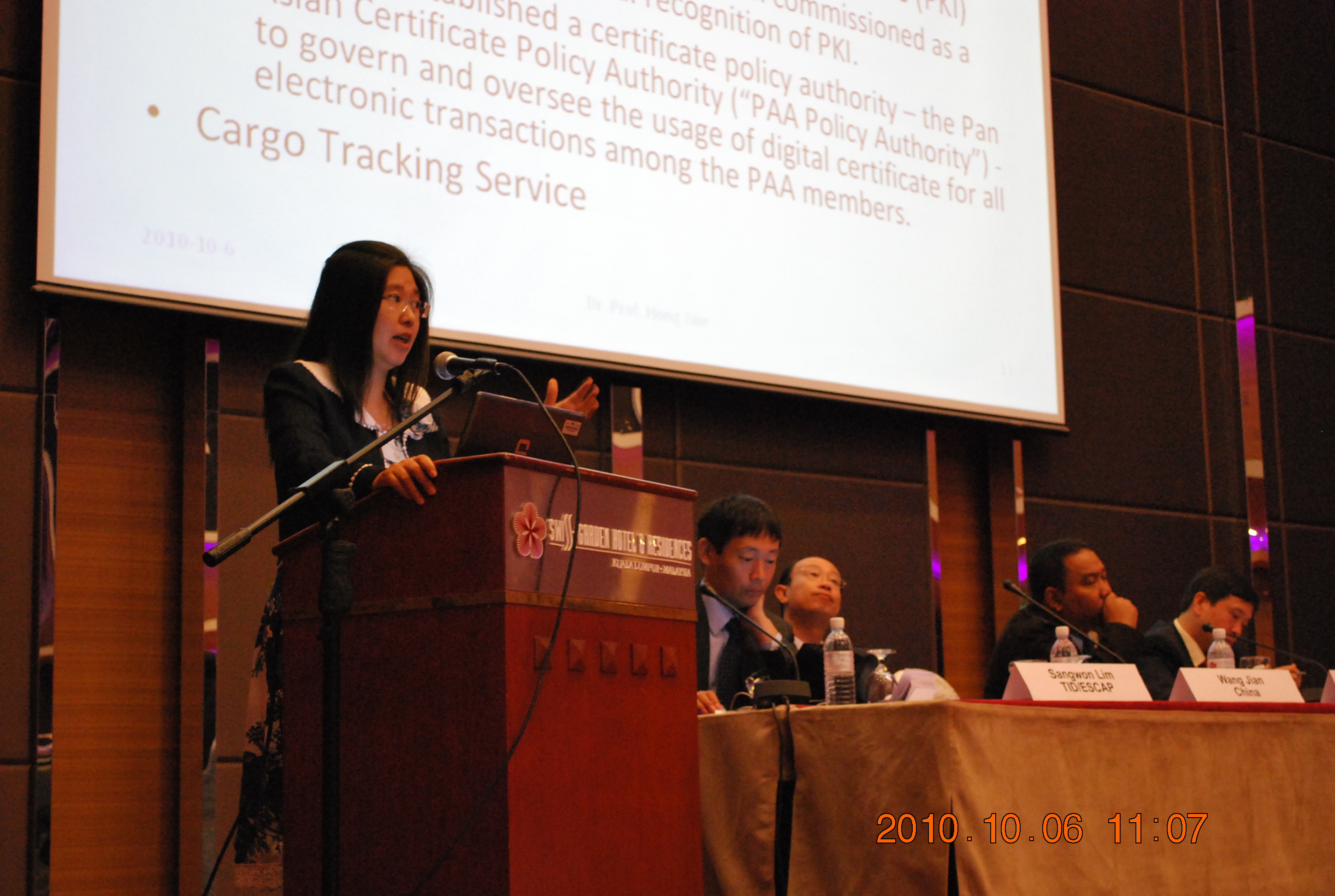
 UNESCAP and UNECE jointly launched the The United Nations Network of Experts for Paperless Trade in Asia and the Pacific (UNNExT) to promote implementation of Single Window and paperless trade.Prof. Hong Xue was the only Chinese and the only legal expert in the group. Prof. Xue is tasked to draft a Regional Agreement on Electronic Exchange of Trade Data and Documents.
UNNExT aims to assist local experts of the region to adopt global standards and solutions for trade document and data requirement simplification and harmonization, as well as to support national, subregional and transcontinental Single Window initiatives in the Asia-Pacific region for trade facilitation.
The first Conference was held in Swiss Garden Hotel, Kuala Lumpur on October 4, 2010, followed with Asia-Pacific Trade Facilitation Forum 2010: “Trade Facilitation for Regional Connectivity: Advancing Paperless Trade” on October 5-6. Prof. Xue presented the analytical study of the draft Agreement to government officials, traders and public and private service providers from Central Asia, South, Southeast and East Asia as well as the South Pacific.
Advisory Group on Legal Framework for National and Regional Single Window has been established in March 1, 2011. Prof. Xue is the only member in the Group from UNNeXT.
Permalink
September 23, 2010 at 4:24 pm
· Filed under APILP-SSIG, Archives, Conferences, Internet Governance

I spent a hectic week (September 13-17) at Vilnius, Lithuania for the 5th Internet Governance Forum. Although the local food is not very impressive to me, I got sufficient food for thought.
On Day One, I rushed to two sessions to give presentations. One was “Setting the Scene” in the Main Room. I’m the author on Chapter Diversity for “official” IGF book “Creating Opportunities for All.” Another was the workshop organized by Council of Europe on Framework of General Principles of Internet Governance, which is a very ambitious project that may have to be handled at UN forum.
On Day Two, I presented at a workshop “Internet Governance and Youth”, along with a critic lady from Pirate Party and a couple of young people. Frankly I don’t believe young people need to be arrogant to the “old” for establishment their own identity. Okay that session was not interesting. In the afternoon, I was the remote moderator for the workshop “Development Agenda.” An irresponsible commentator complained that he could not tweet the session but he lied for he did not even login the webex platform. At night, Prof. Drake and I went to UNESCO reception for a drink.
Day Three was comparatively relaxing to me. I went to the Dynamic Coalition’s workshop at the beginning and SSIG workshop before lunch. In the afternoon, I went to Russian IGF session and Intermediary Liability workshop before joining NomCom outreach. At night, around seven scholars were invited to join UNESCO dinner for a strategic talk. Everyone was so busy with talking or taking notes that we did not remember what we ate.
Last Day began with a Chinese workshop on open access to scientific data and library information. I later joined APrIGF report session. After having lunch with CNNIC friend, I went to city TLD workshop and had interesting dialogue on the large panel. The closing ceremony seemed endless. Prof. Ang, Mr. Tan and I ran into to heavy rain to catch the bus to go to the city for dinner.
On departure Day, Mr. Tan and I went to KGB museum and felt extremely depressed by the execution photos and other old files. Later we felt better in an open market in front of the City Hall. That’s my week by Baltic Sea and my second stay in the beautiful city. Nice to go home anyway.
Permalink
August 14, 2010 at 10:38 pm
· Filed under Archives, Privacy
It was my first contact with a real Internet Cafe in this city. I remember I used kind of public computer access service 10 years ago at my home town. 3 Y for an hour or so. A young boy by the door charged the customers. All I did was to pay in cash. Today I learned I was so outdated after the reform of regulation. When I went to the underground site, I saw a large room with hundreds of computers and a number of users. At the front desk, a man with suspicious accent replied to my query of prices impatiently. After being told that 1 Y for 20 minutes, I presented Y10 as deposit. The man then asked me to provide my ID card, the most important personal document, to him. He got my ID, scanned or stored the information, and asked me to stand in front of a camera to take a snapshot. The whole process was like to screen a new prisoner. Finally I got a small receipt, with my ID number as account number. I manged to login a vacant computer by inputting my ID number. After 10 minutes’ usage, I turned off the computer and presented the receipt to the counter man to get my deposit back. He retained my receipt, on which my ID number was printed.
I took a long breathe after eventually getting back to the ground. I was not only impressed by strict identity monitoring process but shocked by the danger of privacy intrusion and ID theft. The service provider is required by the authority to check, verify and store large amount of customers’ personal information. Are they obliged to keep confident of the information obtained? How can customers know that they will not abuse by forging, selling, leaking the information?
Permalink