Archive for Archives

BNU IIPL成为中国网络空间安全协会理事单位

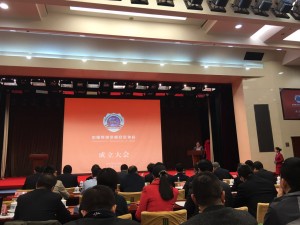
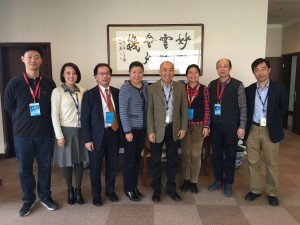
2016年3月25日,中国网络空间安全协会成立大会在北京远望楼宾馆成功举行。BNU作为发起单位与其他150多家会员单位参与了大会。

大会共分为三个部分,第一部分,中国网络空间安全协会第一届会员代表大会。大会通过了协会章程(草案)、选举办法(草案)、会费缴纳管理办法(草案)等重要文件,并选举产生协会第一届理事会,BNU被选举为理事会成员,IIPL薛虹教授为单位代表;第二部分,中国网络空间安全协会第一届理事会第一次会议。会议选举产生了协会常务理事、副理事长以及理事长。根据理事长提名选举产生了协会秘书长。中国工程院院士、北京邮电大学教授方滨兴当选第一届理事长。随后方滨兴教授发表讲话,表示协会将致力于打造“三个一流”的协会,共建能够推进社会、经济、学术等共同发展的网络平台,协助政府管理,维护公共网络安全。

第三部分,中国网络空间安全协会成立大会。中国网信办副主任王秀军讲话,肯定了过去两年中各有关部门为筹备中国网络空间安全协会的成立所做的贡献,指导了协会未来的发展方向。随后,王秀军部长与民政部民间组织管理局巡视员李波共同为协会揭牌。

Comments off

新治理智库联盟预备会议

互联网治理风起云涌,经济发展亮点不断,学术研究不应落后。2016年伊始,又有新的研究形式出现。2月23日,新治理智库联盟预备会议在北京理工大学国际大厦举行,国家行政学院、北大、北师大、北理工等众多学人,阿里巴巴、京东、百度、腾讯等互联网企业,济济一堂,共商新治理议题。薛虹教授在发言中指出,利益有关各方共同参与的新治理模式比较适应互联网的生态系统,可以在实践中探索发展,例如考虑国家互联网治理论坛(National IGF)等形式。薛虹教授还谈到,法律体系与法律研究需要正视互联网的现实,具有挑战传统理论,颠覆传统观念的勇气与决心。互联网上的版权制度就是处于被颠覆的状况,学界却没有足够的想象力,寻找全新的解决方案。薛教授还提到,互联网上平台服务的治理权力,必须在法律层面得到反映,所谓“平等主体的民事关系”不是束缚头脑的借口,即便在传统的民事法律关系中也存在监护等非平等的关系,平台与其用户之间的不平等性真实存在于相生相克的互联网生态系统中。

与会各位均有兴趣继续研究与合作。现在各个大洲都已经有了关于互联网治理的培训课程及相关机制,例如在欧洲有历经十年的SSIG,拉丁美洲有South School of Internet Governance,非洲与北美也有类似的能力建设项目。薛虹教授曾经在亚洲举办过两届Asia Pacific Internet Leadership Project (APILP),并在共同发起Asia Pacific School of Internet Governance (APSIG),主要课程内容包括互联网治理的发展历史、互联网的技术构架、互联网治理的利益有关各方、主要的政策与法律问题,等。在我国与亚太地区发展互联网治理能力建设项目的前景广阔。

Comments off

2015 UNCITRAL ASIA PACIFIC DAY @ Beijing Normal University JCP

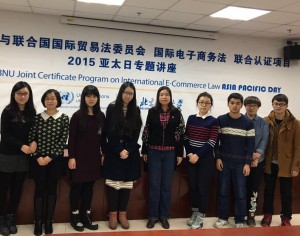
On December 1, 2015, BNU-UNCITRAL Joint Certificate Program on International E-Commerce Law (JCP) successfully organized the UNCITRAL Asia Pacific Day Lecture in the Law School Auditorium of BNU. The Co-Directors of JCP, Prof. Hong Xue, Director BNU IIPL, and Dr. Luca Castellani, UNCITRAL Legal Officer, gave the lectures respectively.

Prof. Xue, at the beginning, gave a briefing of the development of JCP (please refer to the JCP Chronicle at <http://wiki.iipl.org.cn/?cat=11>) and addressed the Program’s great potential on teaching, research and international collaboration. Prof. Xue also circulated the new updated flyer of the JCP to the audience.

Dr. Castellani joined remotely from Vienna and gave a lecture titled “The future of e-commerce law: the UNCITRAL perspective”. Although the same lecture has been presented several time at different occasions in Beijing, Dr. Castellani was always able to provide the updated and fresh knowledge and information and inspired the new thinking in this legal area.

Many BNU post-graduate students joined the Lecture and actively interacted with the Lecturers, despite Beijing’s terribly smoggy weather all through early December 2015. The students’ passion for international e-commerce law is inspiring all the faculties of JCP to work harder to achieve bigger success of the Program.

The Publicity materials for the Lectures shown on BNU campus. The left one is the JCP Officeat BNU and the right one is the Poster for the Lecture

Comments off

Professor Xue Gave the Keynote Speech at 2015 Global Congress on IP & the Public Interest

The Fourth Global Congress on Intellectual Property and the Public Interest took place on December 15-17, 2015 at National Law University, Delhi, India.

The Global Congress was co-hosted by The Centre for Internet& Society, National Law University Delhi, Open African Innovation Research, CREATe, The American Assembly, Columbia University and American University. And it was co-sponsored by OSF, IDRC, Fang.com and Centre for WTO Studies.

The theme for the 2015 Congress is “Three Decades of Openness; Two Decades of TRIPS”, which juxtaposed the beginnings of an aspect of a culture of Openness with that of the establishment of minimum standards of intellectual property protection and the carving of limitations and exceptions within these standards.
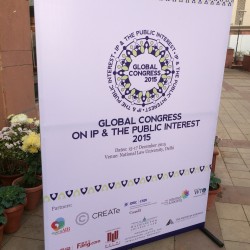
The2015 Congress opened with Plenary Sessions featuring keynote addresses delivered by persons of eminence across disciplines, before having participants break out into theme-specific rooms for presentations, workshops and panel discussions. The keynote speakers were Professor Ranbir Singh, Vice Chancellor of the National Law University (NLU) in Delhi, where the conference was taking place. This was followed by Keynotes from eminent scholars, activists and negotiators – Mr. Sean Flynn (US), Prof. Michael Geist (Canada), Mr. Zakir Thomas (India), Prof. Hong Xue (China Beijing Normal University IIPL Director), Mr. G.R. Raghavender (India) and Prof. Nagla Rizk (Egypt), who all set the scene from the historic to the contemporary context.

Prof. Xue presented on “Rethinking Internet Intermediaries in the International eTrade”, in which she eloquently pointed out that the emerging pervasive cross-border e-commerce has brought up the salient challenges to the current international intellectual property regime, especially customs measures for intellectual property enforcement for international goods trade. The aggregation effect of the traditional de minimis in the international e-trade threatens the customs enforcement that is only suitable for large scale commercial consignments. The blurring line between B2B and B2C in the cross-border e-commerce calls for new information access, enforcement measures and assistance from the critical stakeholders, i.e. Internet Intermediaries or platform services. Prof. Xue emphasized that a 3rd dimension (on platform governance) be recognized and reviewed in the law to enable an updated, effective and balanced IP enforcement for the globalized eTrade. Prof. Xue’s presentation was warmly hailed as one of the most impressive and thoughtful researches unveiled at the 2015 Global Congress.

After the focused keynote speakers and plenary sessions, the 2015 Global Congress carried out discussions through 4 parallel “tracks”, in the fields of “Openness”, “Access to Medicines”, “User Rights”, and “IP & Development”.

 The Global Congress began in Washington DC in 2011, moved to Rio de Janeiro in 2012, and was held in Cape Town in 2013. This year’s Congress featured an additional “Room of Scholars”. “The Room of Scholars” had been conceptualized as that cross­cutting space, not restricted to a particular track but as running along side them. The “Room of Scholars” became an opportunity for the presentation of longer, more detailed academic research papers on the theme of the Congress.

The Global Congress on Intellectual Property and the Public Interest has become the most significant event on the calendar for scholars and policy advocates working on intellectual property from a public interest perspective. The Global Congress supports the formation of strong networks and the dissemination of research and strategies among academics and practitioners, with the aim of empowering them to respond to law reform and enforcement proposals that threaten access and innovation, and to put forward a positive agenda for policy reform.

Specifically, the 2015 Congress sought to produce three outcomes- first, the mobilization of existing scholarly research directly into the hands of civil society advocates, business leaders and policy makers, leading to evidence-based policies and practices; second, the collaborative identification of urgent, global and local research priorities and generation of a joint research/advocacy agenda; and third, the solidification of an inter-disciplinary, cross-sector and global networked community of experts and practitioners focused on public interest aspects of IP policy and practice. The event attended by over 400 scholars, advocates, policy-makers and practitioners, was the biggest global gathering of public interest folk specialized in intellectual property issues in 2015. The 2015 Congress is expected to achieve all three goals it set for itself.
Comments off

UN Promotes the Facilitation for Cross-border Paperless Trade and IIPL Makes the Contribution

The United Nations Economic and Social Commission on Asia and the Pacific (UNESCAP) together with the other United Nations Regional Commissions (UNRCs) launched the first Global Report of the Joint UNRCs Survey on Trade Facilitation and Paperless Trade on October 20, 2015. The Survey, led by ESCAP and supported by the United Nations Network of Experts for Paperless Trade in Asia and the Pacific (UNNExT), was initiated in response to the lack of data on implementation of measures aimed at simplifying and reducing the cost of import, export and transit procedures, including by moving from paper to electronic documents in trade transactions. Implementation of such trade facilitation measures is seen as key to maintaining trade competitiveness and enabling effective engagement of firms, including SMEs, in regional and global production networks. The Survey, led by ESCAP, was developed in collaboration with the OECD and implemented by all UNRCs with the support of UNCTAD, IRU, ITC, OCO and SELA as well as UNNExT experts. Global and regional reports are available at: http://unnext.unescap.org/UNTFSurvey2015.asp

The Global Report provides data for 119 economies around the world and is a useful basis for bench-marking and monitoring trade facilitation performance. It includes information on the implementation of some of the key measures included in the WTO Trade Facilitation Agreement as well as some innovative and technology-driven measures aimed at enabling trade using electronic rather than paper-based data and documentation also referred to as ‘paperless trade’. Key findings from the report suggest that the global average implementation rate of the ambitious set of trade facilitation measures considered in the report is about 53%. Developed economies average implementation rate exceeds 75% while Pacific Island developing economies barely reaches 26%.

The top trade facilitation performer among all the economies included is the Netherlands. Singapore and Republic of Korea lead East Asia, United Arab Emirates leads the Middle East and North Africa region, and Benin and Mauritius lead the Sub-Saharan Africa region. India leads the way in South Asia while Russia and Turkey lead the Europe and Central Asia region. Several leaders emerge in Latin America and the Caribbean including Mexico, Colombia, Ecuador and Chile.

Overall, the Report finds that most economies have already taken concrete steps towards streamlining trade procedures. A significant number of developing economies, particularly in East Asia and Latin America and the Caribbean, have actually implemented many of the commitments associated with the WTO Trade Facilitation Agreement. For most, however, a lot remains to be done. An integrated step-by-step approach is suggested, starting with building up institutional arrangements and inter-agency cooperation.

Going forward, the strong positive relationship found between trade facilitation implementation rates and trade costs highlight the need for countries to strive for trade facilitation excellence. This can be achieved through adoption of modern information and communication technologies, as well as development of legal frameworks enabling exchange of electronic data and documents across borders. These “next generation” trade facilitation measures have just as much potential as more traditional measures to reduce trade costs and boost trade. However, capacity building and strengthened cooperation between countries at the regional and global level will certainly be needed to implement them.

According to the UNESCAP Resolution 68/3 in May 2013 and subsequent Resolution 70/6 in August 2014, the Regional Agreement for the Facilitation of Cross-border Paperless Trade is now being negotiated among UNESCAP member states. Prof. Xue, as the Chair of Legal Panel of UNNeXT, led the drafting of the legal text for the Agreement 2013-2014 and acted as one of the two legal experts to provide concrete legal advices for the intergovernmental negotiation process in April and September 2015 at UNESCAP.

Comments off

« Previous Page« Previous entries « Previous Page · Next Page » Next entries »Next Page »