IIPL-NETMISSION ESSAY COMPETITION 2010
2010年网络使命征文大赛-法律、社会与公益-获奖者揭晓

Winners of  IIPL-NetMission Essay Competition on Law, Society & Public Good

Institute for the Internet Policy & Law proudly announced the winners of the founding yearly essay competition for the students of master-degree and above. The competition aims to promote students’ participation in charity programs via Internet technologies, enhance social responsibility and stimulate public services.

The Competition attracts more than 20 participants from a number of universities in Beijing. The papers submitted covers electronic commerce, intellectual property, free flow of information, management of critical Internet resource and Internet for Development. The Expert Evaluation Committee is very impressed by the students’ knowledge, enthusiasm and strong wish for public good. We sincerely appreciate evaluation experts for their kind contribution of their precious time and energy. Despite all the difficulties we encountered, we are confident in the success of the competition. At Awarding Ceremony, a group of experts on e-commerce, domain names, jurisprudence and Internet policy made very insightful comments on the selected winning papers.

All the winners were awarded the Bilingual Certificates and the prizes kindly donated by CNNIC.

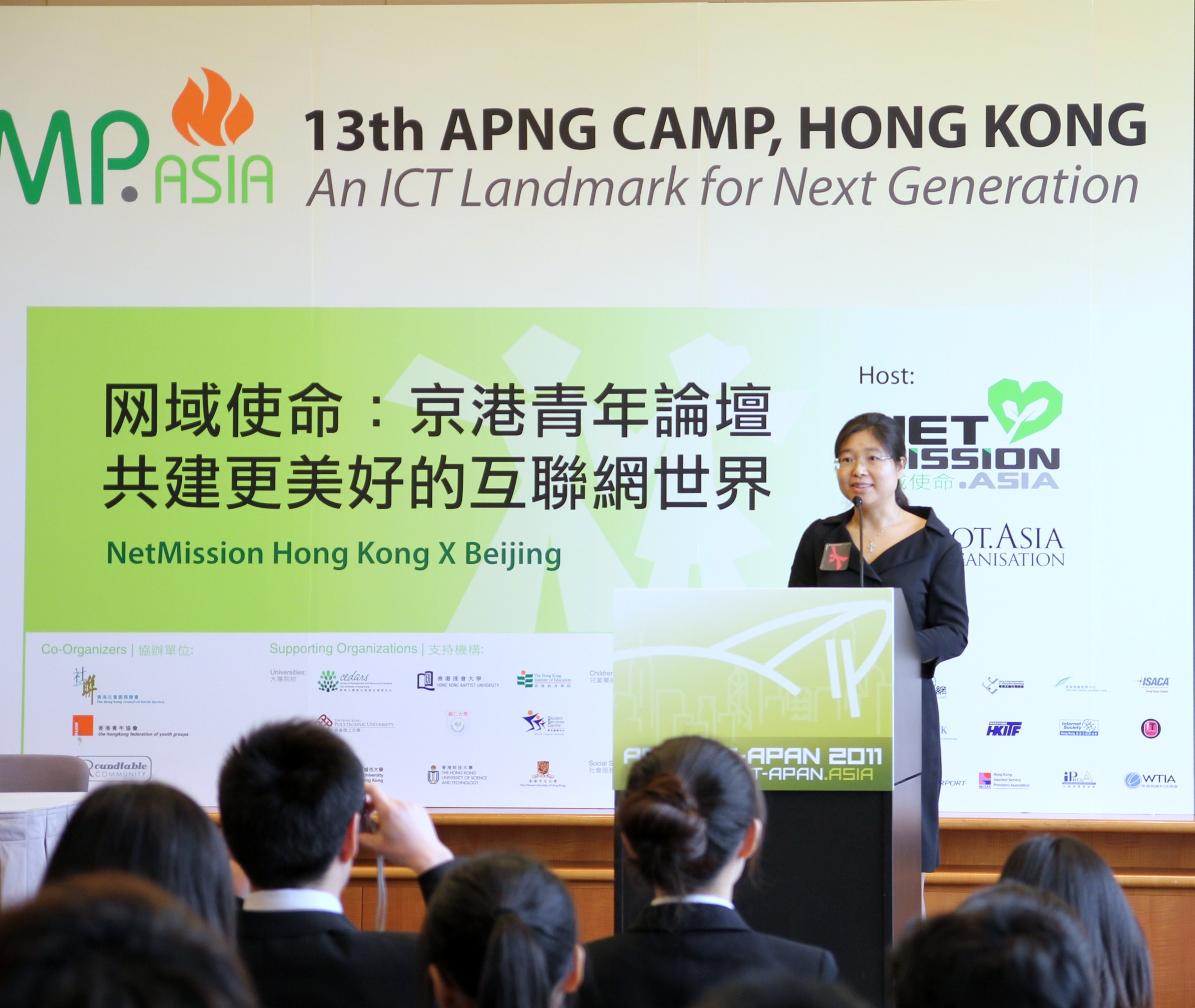
Two winners were later invited by Asia Pacific Network Group (APNG) Camp to present on Beijing-Hong Kong NetMission Join Forum on February 23, 2011. APNG Camp was concurrent to APRICOT 2011, which is the largest Internet conference series in AP Region. Prof. Xue gave a presentation on the NetMission Essay Competition and Youth’s Mission on the Internet. The Director Jiyi Li, Department of Youth Affairs, Liaison Officer of the Central People’s Government in the Hong Kong SAR and Director Florence Hui, Department of Civil Affairs, Government of Hong Kong SAR were present at the Joint Forum.


Winners/ 获奖论文

一等奖 1st Class Winners:

唐慧俊 对外经济贸易大学博士研究生《论电子商务中消费者知情权的法律保护》

Huijun Tang, Ph.D. Candidate of University of International Business and Economics

刘磊 北京师范大学博士研究生《互联网环境下著作权保护博弈对最不发达国家教育资源利用的影响》

Lei Lu, Ph.D. Candidate of Beijing Normal University

二等奖 2nd Class Winners:

刘娟 对外经济贸易大学博士研究生《不同所有制企业基于互联网的商务运营绩效分析》

Juan Liu, Ph.D. Candidate of University of International Business and Economics

伍梦璇 北京师范大学法学硕士研究生《让所有人看见互联网-著作权的社会责任》

Mengxuan Wu, LLM Student of Beijing Normal University

姚志伟 北京师范大学法律硕士研究生《互联网上外国影视作品的著作权保护》

Zhiwei Yao, J.M. Student of Beijing Normal University

三等奖 3rd Class Winners:

吴冬梅 北京师范大学法律硕士研究生《“错案”之外——由“王鹏诽谤案”引发的一点思考》

Dongmei Wu, J.M. Student of Beijing Normal University

赵璐 北京师范大学法律硕士研究生《P2P软件提供者的版权侵权责任研究》

Lu Zhao, J.M. Student of Beijing Normal University

耿珊珊 北京师范大学法律硕士研究生《论网络环境下商业秘密的保护》

Shanshan Geng, J.M. Student of Beijing Normal University

Warm Congratulations to All the Winners! Thanks to CNNIC for kindly donating the prizes for winners!

Thanks to all the participants!


Comments (274)

UNCITRAL Colloquium on Electronic Commerce

UNCITRAL Colloquium on Electronic Commerce took place on 14-16 February 2011 at United Nations Headquarters in New York. The Colloquim was organized in line with the official request of the United Nations Commission on International Trade Law (UNCITRAL) at its forty-third session (2010) to identify a roadmap for future work by the Commission in the area of electronic commerce, with particular regard to legal issues relating to electronic transferable records, identity management and the use of mobile devices in electronic commerce, as well as to discussing recent developments in the area of cross-border electronic single window facilities (see Official Records of the General Assembly, Sixty-fifth Session, Supplement No. 17 (A/65/17), para. 250).

Prof. Hong Xue gave a presentation at the Single Window Session on February 16, 2011.  Prof. Xue presented on the challenges and opportunity of development of Cross-Border Single Window in Asia Pacific Region, referring to the drafting work of a Regional Agreement on Electronic Exchange of Data and Documents initiated by UNESCAP from 2010 and responding to the other panelists’ views on complexity of cross-border legal issues, such as risk of National Single Window service be subject to foreign jurisdiction and ratification of UN Convention on the Use of Electronic Communications in International Contracts. The presentation attracted huge interests from both the panel and the audience.

Comments off

Intellectual Property Dramas in Rabbit Year

Immediately after 1.3 billion Chinese came back to work from the celebration of Lunar New Year–the Year of Rabbit, a few news reports attract the people’s eyeballs.

It’s reported that Chinese has published more papers on technological journals than people from any other country. But the “world record” has an ironical footnote that more than 100 countries rank higher than China regarding paper citation rates. Widespread of copying, plagiarism and other so-called academic corruption explains the large output of rubbish publications.

A more sensational news is that a 2nd-Class National Invention Prize awarded to a research team in Xi’an Jiaotong University was revoked officially because the “invention” contained a large percentage of fabricated or false information. The belated revocation owes great thanks to a group of professors from that University who persistently complained against the corrupt activities in seeking the National Invention Prize.

Two grass-root migrant workers suddenly became pop-stars after a video of their singing a song emotionally got considerable hits on the Internet.  The pains in the song touches ordinary people who work hard for the same goal. They even sang the same song at the Chinese New Year Eve Gala Show, which was viewed by almost 10 billion Chinese. However, the song’s author, Mr. Wang, stood out recently to prohibit the two from singing the same song for commercial performances. The purely legitimate copyright claim angered two new stars’ fans. The anger and hatred against copyright suddenly erupted on the Internet. The Copyright Owner was pictured as mean, jealousy and selfish, although many others urged two new stars to perform their original songs, rather than relying the others’ works.

Comments (15)

Amber Alert on Micro-Blog

Professor Jianrong Yu, from Chinese Academy of Social Science, launched a campaign to save “children beggars” via micro-blog system.

It’s reported that more than 200,000 children were missing in China every year. The number is astonishing. Most missing children were kidnapped and sold to gangsters who use children to beg for money on the streets. There has been a considerable large black market of children trafficking operating many years. The children beggars, as young as 3 or 4 years old, are in miserable condition, frequently being beaten, starved and abused.

Prof. Yu’s campaign is let the people to photograph the children beggars on the streets and post the photos on micro-blog so that the parents of the missing children could find the clue of their babies. Prof. Yu’s call was warmly responded by more than 55,000 micro-blog posts with 800 photos of children. It’s reported that several children were indeed saved by the information revealed on the micro-blog.

However, the civil society campaign could make mistakes. For example, the parents from Shanxi discovered a boy beggar in a photo taken in Zhuhai looking extremely similar to their baby and reported to police. The local police immediately arrested the man who led the said children beggar and declared a success of micro-blog salvation. Sadly, it was too early to celebrate for the family reunion.  The boy was not the son of Shanxi parents.

There are other concerns over the campaign. All the children’s photos are published online. Does it violate the children’s privacy and minor’s legal protection? Would the photos be utilized for illegal purposes, such as commercial ads or extortion by organized crimes? Who is responsible for protecting the children’s personal information?

Fortunately, the campaign has noted these issues. Prof. Yu said a database of missing children will be set up and people’s submissions will not be publicly accessible anyway. Then it arises other issues, such as transparency of information and sustainability of the operation.

Some Congressmen have urged the police to take more effective actions against children kidnapping and trafficking and improve the social welfare system to help poor children, particularly in migrant workers’ families.

Comments (3)

A2K Global Academy Cape Town Meeting

After seven years, I came back to beautiful Waterfront of Cape Town on January 17-19, 2011. This visit was no longer for ICANN but A2K Global Academy, a research network linking up Yale Information Society Project, IIPL and other research centers from Egypt, South Africa, Brazil, etc. The A2kGA had met in New York in 2008 and in New Heaven in 2009. A group of scholars and A2K activists joined the meetings and gave interesting presentations. I personally interested in three topics, i.e. international protection for traditional knowledge, open source study in Arabic countries and Brazilian public participation in copyright law reform. It was a brain-storming meeting for all participants. With respective to development strategy for the institution, it was agreed that new research centers and scholars would be encouraged to join and enhance the visibility at international forum, such as IGF. Prof. Jack Balkin and Mr. Eddan Katz gave inspiring talks on the further development of A2k movement and the Global Academy. I presented on China and Access to Knowledge and received many interesting responses.

Comments (68)

« Previous Page« Previous entries « Previous Page · Next Page » Next entries »Next Page »