《十字路口的国际知识产权法》首发仪式暨域名系统法律问题国际研讨会


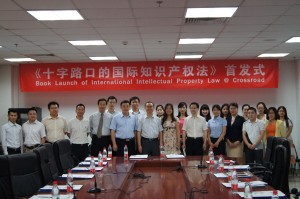
2012年5月31日,由北京师范大学互联网政策与法律研究中心主办、中国互联网信息中心、政务和公益机构域名注册管理中心、北龙中网等多家单位协办的“《十字路口的国际知识产权法》首发仪式暨域名领域法律问题国际研讨会”在1824高铭暄学术报告厅隆重举行。

薛虹教授的著作《十字路口的国际知识产权法》由法律出版社于2012年4月出版。薛虹教授首先简要的介绍了这本专著,指出这本书采用了全新的视角和最新的资料,剖析了国际知识产权法的最新发展,并重构了有关的法学知识体系。薛虹教授对本次会议进行了总结,指出互联网必将深刻的改变法学学科的发展和研究方式、指出2012年是互联网极不平凡的一年,新形态的法律和法学将在网络时代发展和成熟,并导致革命性的变革。

北京师范大学法学院院长、刑事法律科学研究院院长赵秉志教授、互联网政策与法律研究中心主任薛虹教授、互联网名称与数字地址分配机构(ICANN)总裁兼CEO罗德贝克思多先生(Mr. Rod Beckstrom)、中编办电子政务中心主任伏宁先生、工信部崔淑田处长、中国互联网信息中心首席科学家、北龙中网董事长毛伟博士、政务和公益机构域名注册管理中心主任宋庆先生、万网总裁张向东先生等嘉宾出席了会议。

开幕式由薛虹教授主持。赵秉志院长致辞,赵院长向与会者介绍了我院的基本情况,对会议的召开表示了祝贺并表示了他对互联网治理领域的关注与期望。之后,赵秉志院长代表法学院授予贝克思多先生名誉教授聘书,薛虹教授代表互联网政策与法律研究中心向与会的专家领导颁发了国际专家委员会委员的聘书,感谢与会人员对北师大法学两院工作的支持。专家们的加入充实了我院互联网治理研究领域实力,为互联网法律和知识产权法学科的进一步发展打下了坚实基础。

在研讨会环节,来自政务与公益机构域名注册管理中心的刘丽梅女士、北龙中网的冯硕女士、中国互联网信息中心的许超然先生、万网的王娟女士等代表不同单位和部门就日常工作中遇到的域名领域的相关法律问题进行了主题发言。发言主要集中在新增通用顶级域名与商标保护、中文域名管理机制、商标信息交换中心、注册商的法律责任等领域。针对这些主题发言,薛虹教授和在场专家分别进行了独到而深入的点评和讲解,为实务界和学术界相关的问题做出了很好的解答。在场相关工作者和青年学子也就自己关心的问题进行了提问。随后来自互联网名称与数字地址分配机构的罗德贝克思多先生就互联网及域名系统带给知识产权法学乃至整个法学学科的新问题作了演讲。

最后薛虹教授对与会的专家学者表示了感谢,希望他们以后能够长期支持和参与互联网法治等领域的相关工作,也对广大青年学子表达了自己的期许,希望共同促进互联网法治建设出力。

本次会议中,与会人员畅所欲言、气氛活跃而融洽,既为国内外互联网领域的专家们提供了深入探讨法律问题的机会,也加大了我院在互联网领域的学术影响力,更为互联网治理起到了积极的推动作用。

Comments off

Imagining the Future: Global iNet 2012


ISOC’s Global iNet Meeting was on April 22-24, 2012 in Geneva. The meeting is also ISOC’s 20th anniversary and a group of Internet pioneers were honored in the Hall of Fame.The logistic arrangement was fantastic. It was the most thoughtful and sweet-hearted conference I ever attended. I got chocolate and follows in my room immediately after my presentation.

What’s interesting is the two legal panels on Jurisdiction and Copyright Respectively. I was on the Copyright panel. There were fierce debate on every dimension, from stimulation of artistic innovation to free flow of information. When someone attempted to state that IPRs were HRs, it was suddenly rebutted by Mr. Bertrand for lying. Real musicians showed up and revealed that high prices did not go to the creators but to the “music industry”. I talked about the 3rd revision to Chinese Copyright Law and open innovation model.

At closing speech, Francis Gurry, the DG of WIPO, presented his concern about the rival to copyright on the Internet. The impressive point he made was that copyright should be reform to ensure legitimate use of the work would be as easy as pirate ones.


Comments off

GIGA International Conference Series One

The First International Conference organized by the Institute of Global Internet Governance and Advocacy at NALSAR University of Law was held on April 5-6, 2012 in Hyderabad, India. The Conference was named “Revisiting Internet Governance–Lessons Learned and Road Ahead”.

It was not a pleasant journey for me at all. I transferred from Bangkok. After waiting in non-aircon terminal of Royal Thai for 40 mintues, I finally boarded the flight from Bangkok to Hyderabad. Everything was fine until some drunk man hit my head and knocked leaned my glasses. It was incredible. Incredible India indeed. The glassed was fixed once at a local optical but still unusable. I had to put up with the whole week and the following one without glasses. It cost me more than $1,000 to make a new pair after coming back to Beijing. So it was a very expensive trip in my memory.

The conference itself was not bad. I talked in the first panel on an assigned topic “Adding a Billion–Challenges in Asia Pacific Word”. As always, I tried to present the dry topic interestingly. I specifically touched the issues of imposition of legal obligation on ccTLDs and legal enforcement’s threat to DNS  neutrality. People from France, Japan, Jamaica and Gambia joined the conference as well. The domestic present was very impressive. Everyone I know in India showed up. In my blurred view (without glasses), they made forceful presentations from different prospective. Incredible equally.


Comments off

New Book Release: International Intellectual Property Law @ Crossroad

Professor Hong Xue’s new Book is an overhaul of the academic research on international intellectual property law in China. Since China joined the international treaty system of intellectual property rights, the relevant research has primarily been orienting introduction, interpretation and incorporation of the contents of international legal documents, and assessment and examination of the compliance and/or consistence of the Chinese laws with the international laws that China has adhered to. Although the research no doubt provided valuable resources for China to respond to the acute trade pressure from the West and gradually fit in the international intellectual property law system, its backward-looking and responsive methodology can no longer keep pace with the changing situation, internationally and domestically, and its contents need completely updated so as to be continuously valuable for domestic and diplomatic policy-making and implementation.

Since the dawn of 21st Century, international intellectual property law has been changing dramatically, along with the changing situation of international politics, economy, culture and technology. The phenomena of North-South issues, conflicts of IP (intellectual property rights) v. PI (public interests), prolific international regimes and their shifting, more inter-governmental international organizations (IGOs) emerging as new actors and/or fora for intellectual property issues, and multilateral as well as plurilateral and bilateral agreements taking shaping, are redefining the development of international intellectual property law. Internationally, intellectual property issues have been scrutinized under the macro topics such as free trade, market competition, consumer protection, communication rights and free speech, rather than being merely restricted to the private rights and their protection per se.

In the best of the times or the worst of the times, the Book attempts to capture all the key issues of the current international intellectual property law and reassess the fundamental theoretical framework and critical public policy issues involved. The Book is therefore a timely and forceful upbeat in the rhythm of new era of international intellectual property law in China.

The Book depicts the two driving forces behind the new international intellectual property law, i.e. maximalism and reformism, and their primary outcomes, interactions and intertwinement. The maximalist approach, featuring with cookie-cut model and ever-growing and expansive protection for intellectual property rights, has been pushed strongly by developing countries and intellectual property industry. Although Anti-Counterfeit Trade Agreement (ACTA), Trans-Pacific Partnership (TPP) and a variety of bilateral agreements are gaining ground, the negative effect on competition, development and human rights shall not be overlooked. Unlike any other Chinese books that look upon to or lean to learn from the international intellectual property law, this Book reviews both the theoretical basis and legal presentations of maximalism critically.

On the other than, the open communication environment facilitated by the Internet, emerging powers from Global South and, particularly, the global access to knowledge movement, form the strong resistance against maximalism and a vigorous reformative force for new international intellectual property law that is pro-development and public interest oriented. The Book is very first academic addition in China to address the new landscape of international intellectual property law through searching down to the two driving forces and their outside presentations. Such the theoretical framework, critical thinking and new methodology signalizes the new direction on research of international intellectual property law.

In addition to the legal study quality, the Book is multi-disciplinary research that absorbs the latest academic achievements on international political economy, international relation, sociology, Internet technology and Internet governance. The Book contains the most refreshed information and original analysis updated to 2011, when the Book was completed. The chapters on enforcement measures on ACTA, TPP, and ICANN new gTLD program have never been researched in China and most parts of the world. It is believed that the Book bring the Chinese study on international intellectual property law to a new stage that is comparable with the most advanced and acknowledged research in the world.


Comments off

ICANN Meeting in San Jose

ICANN 43rd International Meeting was held in San Jose, Costa Rica on March 11-16, 2012. The cloudy great volcano likes wearing a white hat, symbolizing the most green country in Caribbean sea. It was a long trip from Beijing to Los Angeles to San Salvador to San Jose, almost 2 days on road. The tiredness did not prevent a group of us from driving a few hundred of miles to visit the Volcano. After enjoying a volcanic hot spring  and a short night in a country inn, we drove to the Great One in the early morning. Unfortunately, we did not see the miracle circle top in the white cloudy dawn. But a a visit to a mountain-view was pleasure and refreshing. Then another long drive back to the conference hall in Ramada Hotel. I immediately joined the ccNSO Strategic Operational working group meeting.

From Monday I have been busy with a variety of meetings in different constituencies. In the afternoon, I noted the seriously biased IDN Variants Project Plan and had a long debate with the ICANN team to be funded by million of dollars against their unfair treatment to Chinese-character set.

Tuesday was a busy day full of ccNSO meetings. I made a presentation in the most interesting session of the whole meeting, “law enforcement”. After a couple of boring briefings on SOPA bills etc., MX and KR, my presentation on the domain names real names campaign attracted huge attention. People from GNSO or other stakeholder group joined the meeting and kept asking questions. What’s interesting was that a few non-professional and self-nominated “cyber-watchers” irresponsibly reported my presents to the domestic authorities, which got me in trouble later on after my coming back to Beijing.  Were they officious or wicked? I don’t know but they did waste tax-payers’ money to travel 10,000 miles to espionage me in San Jose. On the other hand, Internet-cleaning campaign was propagated by themselves as a big achievement. Idiots ain’t they?

Poor me was working hard to organizing a Chinese community meeting when being spied by these brainless amateur spies. I chaired a land-mark swimming pool meeting on Wednesday morning. I briefed them on IDN variant issues and the threat of project plan, and addressed the trademark clearing house. Then I arranged the group of people to attend the different meetings to voice the Chinese community’s concerns. Knet, Conac, dotAsia, Cnnic and a few new gTLD applicants and registrars joined the meeting. On Wednesday morning, I gave another speech on registrations by individuals under dotCN. I assume it succinctly follows the lines this time. Whose line is it anyway?

Thursday morning I spent a little time in the downtown of San Jose. It was pretty small but reasonable. I came back in time for the public forum in the afternoon. Surprisingly there were not many tough questions this time. People got tired after debating for more than 10 years.

Friday morning I took a walk on the Golf Course nearby but was lost eventually. That was bad experience and also a bad sign actually–the beginning of my long torment. I’m leaving for the airport at noon. I lost my luggage en route–San Jose to Miami to Los Angeles to Beijing. I suffered terribly in those 5 days.


Comments off

« Previous Page« Previous entries « Previous Page · Next Page » Next entries »Next Page »